There is a moment many researchers know well. You finish a paper, you want to publish it, and before you even think about writing you already have a checklist: deposit the data in the right repository, complete the management plan, verify the license, confirm the funder allows it, check whether the journal supports open access or whether you need to pay an APC. Somewhere in that process, almost without noticing, you lost track of why you wanted to publish that work.
That is not a problem of attitude or lack of commitment. It is the result of a system built around a particular logic, one that N. Lund examines in a recent article in the Journal of Documentation.
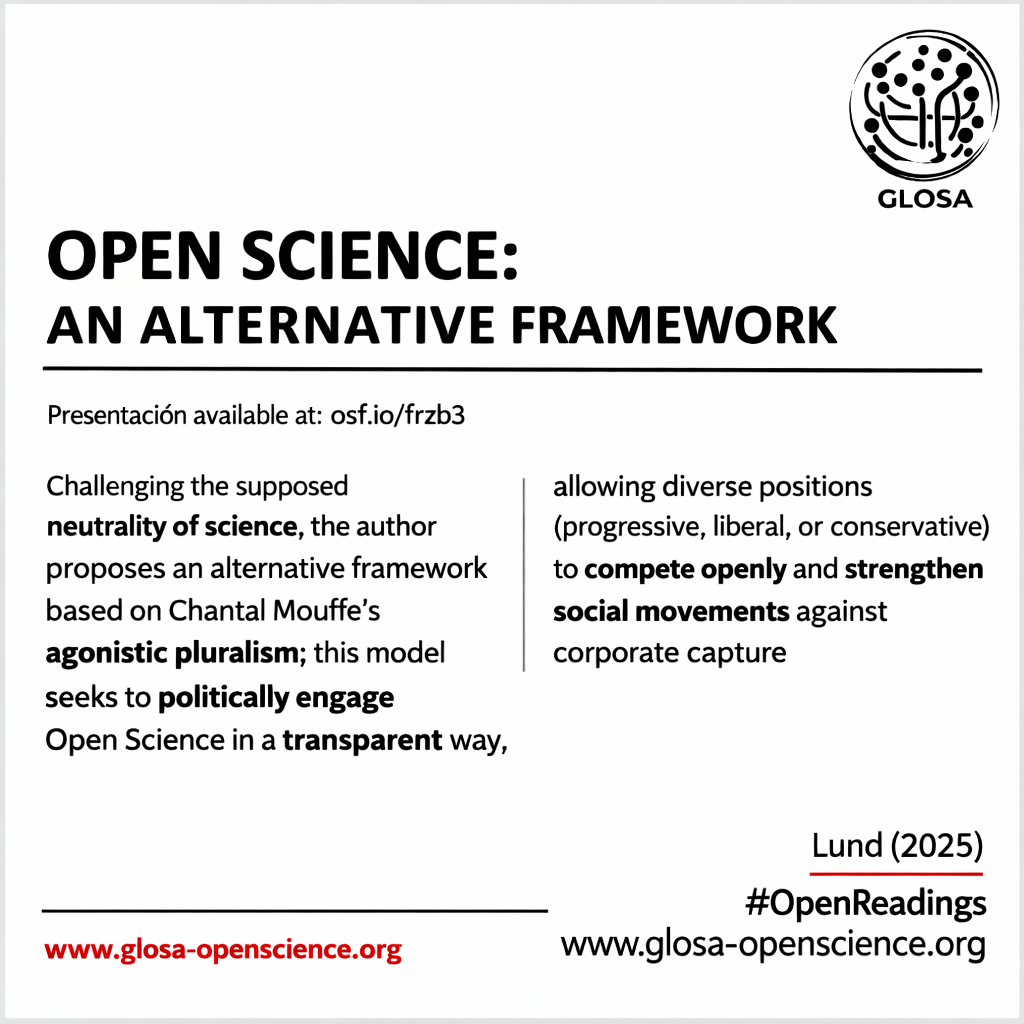
Lund (2025) identifies something many researchers sense but rarely name: the dominant institutional framework for open science presents as technical and neutral a set of mechanisms that have very concrete consequences for who controls knowledge. One example from the article: R&D contracts with private companies include clauses allowing publication delays of four to six months, the time a company needs to secure its patents. Openness, in those cases, waits. So does the researcher.
Lund’s argument does not reject openness as a principle. What it shows is that the current model has turned open science into an administrative burden for those who do the research, while leaving intact the mechanisms that allow knowledge to be closed or withheld when it suits other actors. Mandates accumulate on researchers. Exceptions are negotiated by institutions and companies.
For the GLOSA community, this diagnosis describes something that happens every day in labs, research groups, and thesis projects. Researchers and students who follow open science mandates with genuine conviction find themselves absorbed by procedures that lack adequate institutional support, time, or clear guidance.
The problem is not wanting to share knowledge. It is that the costs of doing so fall disproportionately on those with the least power in the academic system, while the system as a whole continues operating with its asymmetries intact.
Throughout March, GLOSA will work through this diagnosis in a series of posts drawing on Lund’s article and grounding it in concrete situations: data management plans, APCs, institutional repositories, the relationship between private funding and open access, and the question underneath all of it: who gets to define what “open” means?
Article available at: https://doi.org/10.1108/JD-09-2024-0220
Our presentation for the Spanish Speaking Seminar available at osf.io/frzb3
 GLOSA
GLOSA 
Leave a comment